How I Passed CFA Level I - And Why It Was Worth It
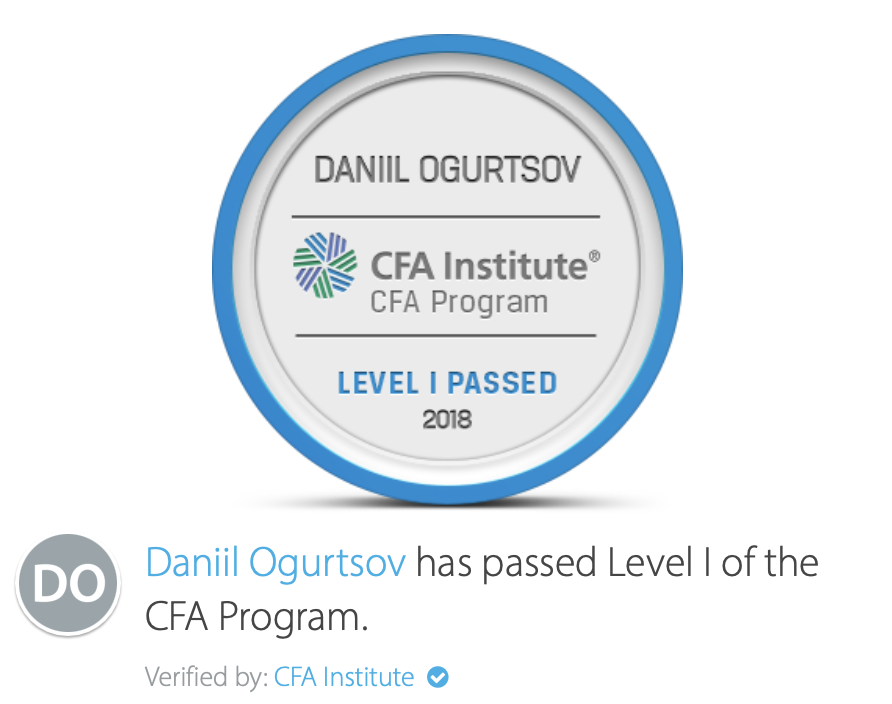
I passed the CFA Level I exam back in 2018.
I even still have the digital badge.
At the time, I was studying for a Master's degree in Finance and, like many ambitious finance graduates, I was aiming for a career in investment banking. CFA felt like a very natural step: a way to deepen my knowledge and, at the same time, get an external validation that my understanding of finance was solid.
CFA Level I is widely known as a difficult exam, and not everyone who starts this journey finishes it. That reputation alone already gives the achievement weight.
After passing Level I, I registered twice for Level II and prepared seriously both times, and failed both attempts. Strangely enough, this only reinforced my respect for the program. For me personally, it confirmed that passing any CFA level is a real achievement, not just another exam you casually check off a list.
And I will try the third time :)
But this article is not about Level II. It's about Level I, and what that experience taught me.
A Tough Exam With a Serious Commitment
CFA Level I is a demanding exam that officially requires around 300 hours of preparation at a minimum. From my experience, that number is realistic.
I believe Level I provides an excellent financial foundation, even for people who do not necessarily plan to build a long-term career in finance. And for those who do want to move into finance without spending another three or four years on a formal degree, CFA Level I is one of the most efficient paths available.
In a relatively short but intense sprint, you are exposed to almost every major area of finance. Level I focuses heavily on fundamentals, and that breadth is its biggest strength.
Even With a Finance Background, It Was Hard
I already had a solid finance education, yet preparing for Level I was still challenging. The volume of information is enormous, and many topics were either completely new to me or only lightly covered during my university studies.
On top of that, my English at the time was noticeably weaker than it is today. For any non-native speaker, this adds another layer of difficulty, especially when dealing with technical concepts, dense readings, and time pressure during the exam.
What makes the CFA system particularly interesting is how the exam is graded. You never know the exact passing score in advance. The difficulty of questions can vary from year to year, and based on how candidates perform globally, the minimum passing score is adjusted.
Everyone around the world takes the same exam, on the same day, under the same conditions, native speakers and non-native speakers alike. I genuinely like this system. It feels fair and transparent. At the end of the day, it's just you and the exam.
My Preparation Strategy
I started preparing nine months before the exam.
In the beginning, I studied around one hour per day. But during the last four months, my preparation became much more intense: around four hours every single day, while still combining it with my studies.
Even with that effort, I honestly feel that I didn't fully understand about 20% of the material. Fixed income and the fundamentals of derivatives were the hardest for me. I learned the mechanics, memorized key ideas, and practiced many questions, but I didn't deeply internalize the logic behind everything.
That deeper understanding came much later, when I started preparing for Level II.
At Level I, my strategy was pragmatic:
- learn the core concepts,
- practice as many questions as possible,
- and accept that perfection is unrealistic (+learn to manage timing).
Exam Day and Outcome
Without going into exam specifics, I can say this: Level I felt easier than I expected, and noticeably easier than my mock exams.
Mocks felt brutal. The real exam felt more manageable.
That difference gave me confidence during the test, and in the end, I passed.
Final Thoughts
Looking back, CFA Level I was one of the most intellectually intense things I had done up to that point. It required discipline, consistency, and a willingness to sit with uncertainty and overload for months.
At the same time, it gave me a structured understanding of finance that I still rely on today.
Even though my CFA journey after Level I did not go exactly as planned, I have zero regrets about starting it. Passing Level I was worth every hour I put into it, and failing Level II only reminded me how real and meaningful that achievement was.
If you are considering CFA Level I, know this: it is hard, it will test you, and it will demand sacrifices. But it is also one of the most honest and globally respected ways to challenge yourself intellectually and professionally.
And sometimes, that alone is reason enough to try.