Debt: The First 5,000 Years
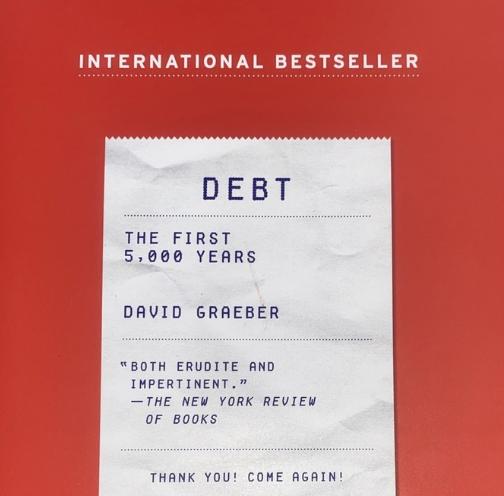
Debt: The First 5,000 Years — by David Graeber
I've read a lot of books like this one. A whole pile, actually - a few back in university, more during my early years in finance, and plenty since then just because I keep coming back to the topic. Money, where it comes from, why it behaves the way it does. It's one of those subjects I never quite finish with.
Lately I was in a particular mood. I wanted to step back, go up a level, get some altitude. Not another book about markets or trading or "how the economy works" this quarter, but something that looks at money from far away, across the whole span of history. I had a few candidates on the shortlist. This is the one I went with.
One idea that was new to me
The thing I'd never actually heard before: debt came before money.
We all get taught the same little story - first people bartered, a chicken for some grain, then that got clumsy, so somebody invented money, and credit showed up later. Graeber says that story is basically a myth. No anthropologist has ever found a real society running on pure barter. What they find instead is credit - IOUs, "I owe you one" - debt first, coins much later.
Okay. Interesting. I'd honestly never looked at it from that angle, and I like it when a book hands me a new lens like that.
Am I convinced? Not really. I'm skeptical about big claims stacked on ancient history. Our picture of what people were doing 4,000 years ago seems to get rewritten every twenty years or so, and whatever feels like settled fact now will probably read as outdated later. So I hold it loosely. But as a thought - a "huh, maybe it really was like that" - it stuck with me. That alone was worth the read.
One more thing I appreciated: the book doesn't collapse into radicalism. I've read enough books that do, and I'm a little tired of it. This one keeps a fairly even tone. There's a lean, sure, but it mostly stays on the historical side of the line, and after a while that restraint feels like a small gift on its own.
The parts that are hard to argue with
When the book sticks to history and anthropology, it's strong, and a few threads stayed with me. Debt is older than money, and money is older than coins - first came the tabs people kept on each other, then units to count them, then the metal. Money was never really "natural" either; it shows up hand in hand with states, temples and armies, more a tool of organization and power than something that bubbled up from a village market.
The part I keep thinking about is simpler: turning a relationship into a precise number is what makes it cold. A favor you owe a neighbor can't be measured exactly, and that's kind of the point. The moment it becomes "you owe me exactly this much," you get leverage, and sometimes something worse. He also frames history as swinging between long eras of virtual, credit-based money and eras of hard metal, back and forth, and argues we're living through one of those swings right now.
None of it reads as dry theory. It's stories, across a huge sweep of time and places, and that's the book at its best.
Where I quietly stepped off
Then there's the last stretch, where the book walks into the modern world and starts drawing conclusions about today. That's where it lost me a bit.
I read those parts carefully, the way I read that kind of thing in almost any book now. Because it is almost any book; everyone has an angle once they reach the present. I respect the author's opinions, I just don't file them under "the research." I keep those two drawers separate: the historical work is one thing, the modern prescriptions are another, and each reader can decide for themselves whether to buy them.
And the subject is hot. Especially now, especially in the West, this is the kind of topic where people stop reading and start picking sides. So I'd sooner leave that door open. People can walk through it or not.
Would I recommend it
Yes, with a filter. Read it for the long view - for the strange, genuinely interesting history of how humans have owed each other things for the last five thousand years. Take the ancient claims as interesting rather than settled, treat the modern conclusions as one man's opinion, and you'll still walk away looking at money a little differently.
Which was the zoom-out I wanted.