The Private Perp Exchange You Can Always Leave Doesn't Exist Yet

On May 31, 2025, Jeff Yan, the co-founder of Hyperliquid, posted a long thread arguing that for most whales, trading in the open is better than trading in the dark. Market makers can see your flow, so they can provide liquidity to it, and you get better execution. And no, he wrote, liquidations are not hunted on a transparent venue more than on a private one. The next day CZ answered with a post that got four million views: "If others can see your liquidation point, they could try to push the market to liquidate you. Even if you got a billion dollars, others can gang up on you." He said now was a good time for someone to launch a dark pool perp DEX, and that it "should be doable with ZK or similar encryptions." Two days later Jeff Yan came back, held most of his ground, and gave up one point: "Most would agree that unlike size information, preserving margin privacy is beneficial for the end user. Perhaps a ZK privacy implementation can accomplish this in the future."
That is the founder of the most transparent exchange in crypto and the founder of the biggest centralized one agreeing on one thing within four days: hiding your margin would be good for you. Jeff Yan still thinks size and flow should be public. But your liquidation price is exactly the kind of margin information both of them would rather not see exposed. And on Hyperliquid it very much is. Anyone can send one request to its public API, with no key, and get back the position, the leverage and the liquidationPx of any address. The liquidation trackers people use are mostly drawing that data. In March 2025 a well-known trader publicly called for a team to "hunt" a 40x BTC short that had grown past $445M, and posted "the hunt has begun." As far as the reports go, the whale was never liquidated, but the target was public for everyone to see. In late May 2025 James Wynn was posting his own exact liquidation price and saying the market was being pushed into it. Whether anyone actually hunted him is his claim. What is on-chain is that he was liquidated for about $99M in a single week.
Hiding the number doesn't stop everything. On Binance positions are private, and people still build liquidation heatmaps from open interest and leverage and trade toward the clusters. Forced orders end up on the public tape anyway. On Hyperliquid you just don't have to estimate the cluster, because you can read the address.
The market answered fast. Nineteen days after CZ's post, Aster launched Hidden Orders: your order doesn't show in the public book until someone trades into it. That hides you from other traders, but not from the exchange itself. In December 2025 Paradex went much further and encrypted the whole state of the exchange, so orders, positions, balances and PnL are visible only to the account holder and the operator.
What sets a ZK exchange like Lighter apart from a centralized one is that you can always leave. Even if the operator disappears, freezes, or turns hostile, you can take your money out without asking anyone. That promise works for a very specific reason: the exchange's data is public, so anyone can rebuild anyone's balance from it. Encrypt the data, and you are touching the thing the exit runs on.
So the two things traders want, privacy and a guaranteed exit, collide, though not where I expected. The pieces needed to have both are already running in production, in different systems, and none of the venues I looked at has put them together.
How the exit works
A ZK exchange runs its matching engine on the operator's servers, like any centralized exchange. Every few minutes it sends two things to Ethereum: a proof that everything in the batch was computed by the rules, and the data itself, the changes to every account, posted as blobs. The proof means the operator can't break the rules: it can't credit itself a balance or skip a margin check. It can still feed in bad inputs, like a price, which will matter later. And a proof doesn't make anyone keep running the servers. So what happens when the operator stops?
On Lighter the answer is called desert mode. You send a withdrawal request directly through Ethereum. If the operator doesn't process such requests for 14 days, the exchange can be frozen for good. From then on you rebuild the state yourself from every blob since launch (Ethereum nodes drop blobs after about 18 days, so in practice from an archive), generate a ZK proof of your own balance, and submit it to the contract to get your money. Open positions are closed at the last mark price, the exchange's own fair price that it also uses for PnL and liquidations.
One thing didn't add up. Lighter's page on ETHBEAT (called L2BEAT until 2026) says positions close at the index price, the average of outside spot prices. The desert circuit in Lighter's public repo has no index price field at all, only mark. ETHBEAT also notes that the source of the currently deployed desert verifier isn't published, so I can say what the public code does, not what is running.
There's no one-click tool for any of this yet. The circuit and the tools that turn raw blobs into proof inputs are public, but putting them together is on you. And Lighter's upgrades so far have all been fast-tracked, which matters, because an exit is only as strong as the delay on upgrades.
What a perp trader gets back here is collateral. The trade itself sits frozen for at least two weeks and then settles at a price from before the freeze, so anyone hedged on another venue is unhedged that whole time.
This kind of exit has been used for real. When dYdX v3 shut down in October 2024, L2BEAT built an open-source explorer with dYdX and StarkWare that let users withdraw through the escape hatch. In the first eight days people pulled out almost $30M, and more than $70M was still sitting there. It worked because StarkEx published the full state on Ethereum, so every user could build a proof of their balance without anyone's help. Today, your exit depends on everyone's data being public, because that's how you rebuild the tree your balance sits in.
Paradex's privacy launch said in plain words that it closes the path of "reconstructing aggregated balances from the L1 data availability." The blobs on Ethereum are now encrypted, and the decryption keys sit with a Privacy Council of three members: the Paradex Foundation, Paradex itself, and Karnot. Paradex never had a Lighter-style exit in the first place. ETHBEAT notes "there is no generic escape hatch mechanism as Starknet cannot be forced by users into a frozen state," and its contracts can be upgraded with no delay. But privacy added a second dependency on top: "Funds can be frozen if no privacy council member discloses the decryption keys." Paradex's own docs say that if the exchange becomes inoperable, the council can decrypt and publish the state so a recovery is possible. That only works if the council decides to, and even then there's no mechanism that lets you withdraw on your own.
In January 2026 L2BEAT moved Paradex out of the rollup category and into "Others," and one of its researchers described the new setup as "equivalent to a 3/3 DAC," a data availability committee. The two numbers describe different things: any one member can save you by publishing the keys, but you have to trust all three, because each of them can see the data and none is forced to act. The proofs still stop the operator from breaking the rules in a given batch, but your money can be frozen.
The other exchanges selling privacy are in the same place or further from an exit:
| Venue | What is hidden | Who holds the key | Exit without the operator |
|---|---|---|---|
| Lighter | Nothing from the public (account data is posted in the open) | No key needed | Yes, desert mode (but upgrades have been fast-tracked) |
| Paradex | Orders, positions, balances, PnL | Council of 3 | No forced exit; state recovery needs 1 of 3 to publish |
| Hibachi | Balances, positions | Hibachi (per a partner's 2025 post) | No, "working towards" one |
| GRVT | Everything, data stays off-chain | Operator | No |
| Aster | Hidden orders kept out of the book; on Aster Chain, balances and positions | Not disclosed | Not applicable, it's Aster's own chain |
Hibachi is the one I keep coming back to. In July 2025 a post on Gelato's blog said "Today, Hibachi owns the decryption key, but that will change," with the plan to give every user their own key. About sixteen months later, Hibachi's own docs don't mention the decryption key or an exit at all, and the most recent word, from Celestia in January 2026, is that Hibachi is "working towards a path where users may be able to recover funds."
Where users hold the key
There are systems where the user holds the key, and they do have an exit. They also show what it costs. Take Aztec v6. It became the canonical version in late October 2026 and sits at Stage 2 on ETHBEAT, the top rating, meaning users can exit even if the team turns against them. The exit window is listed as infinite, the contracts can't be upgraded, and in its constrained delivery mode the encryption of a private note to its recipient is checked inside the circuit, so the sender can't hand you garbage. That's verifiable encryption: the proof shows the ciphertext really holds the right data for the right key. A private exchange would need exactly this. It also holds about $259 (it only became the canonical version two weeks ago). And the reason v6 exists at all is that a critical vulnerability was found in v5's proving system on July 27, 2026. Since nothing could be upgraded, the fix was a fresh deployment, three months later.
Renegade, a dark pool on Arbitrum and Base, does have a real exit. In July 2026 it shipped a small CLI for its v1 deployment that rebuilds your wallet from the contract's on-chain events, builds the proof locally, and withdraws "WITHOUT the relayer, prover-service, or any other Renegade infrastructure." That protects you from the relayer. It doesn't protect you from the contract owner: the owner can call pause(), and both wallet updates and withdrawals stop while it's paused. And the relayer, which does the matching, sees your whole wallet.
INTMAX was built so that users keep their own data and prove their own balance to withdraw. Then in February 2026 withdrawals were paused over a bug in its balance proof circuit, and the replacement exit, as documented, works like this: you hand your view key to INTMAX's server, the server recalculates your balance, incoming transfers count only if the sender also handed over their view key, and the withdrawal is submitted by the backend, where a guardian can still cancel it. A research site called EthSystems has a good line for this whole category: there is a "five-step gap between 'data exists' and 'exit succeeds'." You need the data, your own secrets, and a prover that still matches the contract, and as they put it, "a version mismatch means funds are frozen until governance acts."
What the exit proof reads
Up to here it looks like privacy kills the exit, the end. For perps my first guess was that it's even worse: your margin depends on the market, the market is everyone, so proving your balance should mean revealing everyone. It doesn't. The easiest way to see why is to look at what the desert circuit in Lighter's public repo takes as input.
It reads your own account leaf, which is your entry in the state tree the exchange commits to Ethereum: your balances and up to 255 positions, where a position is stored as just a size and the last funding checkpoint it was settled at (there's no entry price in there). It reads the full accounts of the pools you hold shares in, like the LLP vault. And for each perp market it reads three numbers: the mark price, the cumulative funding, and a per-market scaling factor (there's a separate bit for Lighter's binary options markets, which works the same way). Your value is computed from that: position size times mark, plus funding owed since your last checkpoint, plus your balances.
It doesn't read other traders' positions, the order book, open interest, margin parameters, liquidations and auto-deleveraging. None of that goes into the proof, so your exit doesn't need anyone else's position. On paper, a perp exit and privacy for other people's positions get along fine.
Lighter even has the split already. Its state root has a public part and a part that never leaves the operator. Order books, the full account records (open orders, settings and so on), risk parameters and config all sit under a branch called validium_root (validium being the term for data that stays off Ethereum, with only a hash on-chain), and that branch enters the exit proof only as a single opaque hash. What does get posted is a trimmed version of each account, the leaf with balances and positions, plus the per-market numbers. So a "private Lighter" would not need to start from scratch. The core change is to the account leaves: post them as salted commitments instead of plain hashes (a small account can be guessed from a plain hash), with an encrypted copy to each user's own key, and prove inside each batch that the copy is correct. Market numbers and pools stay in the open.
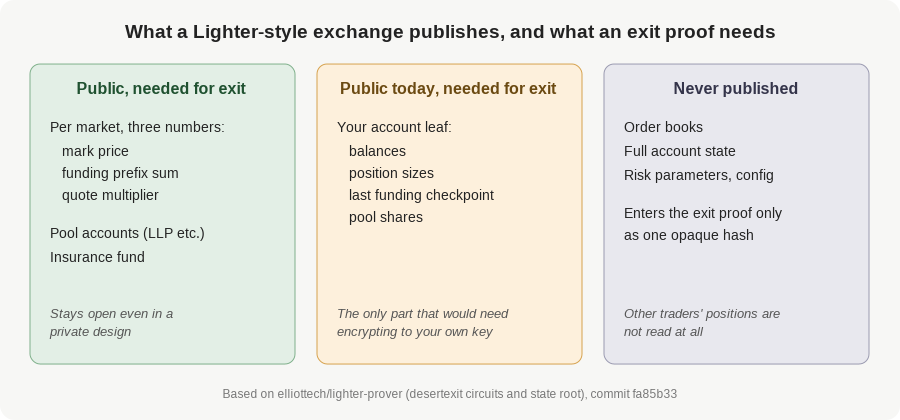
Only the middle column would need to become private. Other traders' positions are never part of the exit.
So nothing in the math rules it out. What nobody has measured is the cost of encrypting every changed account inside every batch proof. I don't know that number, and it could turn out to be the real blocker.
What the math doesn't fix
In desert mode every position is closed at the last mark price. In normal trading the operator computes that mark with its own formula, and the circuit doesn't check how. In the public code, Lighter's main circuit takes it in as a plain 32-bit number, checks that it's in range and not zero, and that's about it. No oracle signature, no freshness check. The exit circuit then uses the last value that was proven. With public positions, a strange mark right before a freeze would at least be visible, and you could see whose positions it hurt. With private positions you can't see whom it was moved against. The same goes for ordinary liquidations: the batch proof still checks each one against the rules, but nobody outside can see who was liquidated or at what price, so you're trusting the proof and whatever mark it was given.
There is a known fix for part of this. StarkEx, the engine under dYdX v3, verified oracle signatures inside its circuit back in 2021. It checked that each signer was in an on-chain list, that there were enough of them, that the price was their median, and that the timestamp was fresh. To keep it cheap it ran the full check only for the lowest and highest price of each asset in a batch.
Signatures only cover part of it, though. Lighter's mark isn't a single oracle price: it mixes in prices from other exchanges, and nobody signs those. An oracle can sign the index, and the prices from Lighter's own book are already computed inside the circuit. So the cleaner exit may be to settle at a signed index, not at mark. Which is, funnily enough, what ETHBEAT already says Lighter does.
Solvency is the second problem. In the public contract code, Lighter pays desert-mode withdrawals first come, first served, with no check that there's enough for everyone, and the circuit sets negative balances to zero instead of passing the loss to someone. If the exchange had bad debt when it froze, the people who withdraw last are the ones who find the vault short. Today you could at least estimate that from the public balances. Hide the balances and nobody outside can. Binance has published a zk proof of reserves since 2023, which proves exactly this kind of thing: that hidden balances are covered by the money held. The same idea could run inside every batch. Each batch proof publishes the total positive equity in the system, and the contract pays everyone pro rata instead of first come. The hole stays the same size, but it gets shared instead of landing on whoever withdraws last. And since that total is computed at the same closing price, it inherits the price problem above.
Pools and the insurance fund are shared by definition, and anyone with a share needs to see them to prove what they own. So they stay public, and that has a cost: a vault that trades against users and absorbs liquidations leaks some of that flow through its own position changes. Privacy here would be for traders' positions, and only partly.
The building blocks for all of this are already running somewhere. Paradex's proof already checks that its blobs were encrypted correctly. It's verifiable encryption in production, aimed at the council's keys instead of the user's. Aztec v6 proves encryption to the recipient's key. Celestia has open-source code for verifiably encrypted data, which Hibachi uses, though it proves that some key encrypted some data, not that it's your key or your account. The version where each user sets their own key and can force their own exit is still only a proposal on a forum.
FHE and MPC don't help with the exit. On Zama a withdrawal from a confidential token needs a decryption signature from a threshold of key nodes (their docs give 9 of 13 as the example), and on Fhenix from a TEE that holds the decryption key. It's still a committee, only with fancier math.
Put the working pieces together and the minimum design looks something like this:
- each user's account state encrypted to that user's own key, with the correctness of the encryption checked inside the batch proof;
- account leaves stored as salted commitments, with the changes posted so anyone can rebuild the tree;
- a public aggregate of total equity, and pro rata payouts on exit;
- a closing price backed by oracle signatures checked in the circuit;
- pools and the insurance fund kept public.
Jeff Yan's main point in that thread was about who gets to see. On a centralized exchange your liquidations are visible too, just to insiders, and his ranking was "the system knows" > "no one knows" > "some people know." A private Lighter built this way lands in his last bucket: the operator sees every position and every liquidation level, the market sees nothing. It still beats a centralized exchange in two ways - the operator can't break the rules, and it can't keep your collateral forever. On the question Jeff Yan raised, though, this design sits with CZ. Outsiders would also still see which accounts changed in each batch and when, the amount and address of every deposit and withdrawal on Ethereum, and whatever leaks out of public numbers like open interest. And if you lose your key, you lose your money.
Why nobody has built it
Part of the answer is that demand is louder in posts than in numbers. Paradex's open interest went from about $153M on average in the month before privacy launched to about $270M in the month after, though that was also the run-up to its token. Then it fell more than 96% from its peak of about $362M in late January, to around $12M today, overlapping with a chain rollback in January, the token launch in March and the end of zero fees. Too much happened at once to credit or blame privacy for any of it. Hibachi's open interest is around $1.5M, against roughly $7.3 billion on Hyperliquid. Renegade, a spot dark pool, holds under half a million in deposits. Nobody has made privacy pay yet.
There's probably a reason that has nothing to do with cryptography too. A venue that works with brokers, banks or regulators needs someone who can see the data and hand it over when asked. A council or an operator holding the keys is also how a venue stays compliant, and giving every user the only key cuts against that. I can't prove this is why Paradex and Hibachi chose what they chose, but I'd guess it weighs more for the people building these exchanges than the proving cost does.
The other part is that exits almost never get tested. dYdX v3 is the one big real case. When ZK exchanges and rollups closed in 2026, it mostly went through admins instead. Loopring replaced its contract and is handing funds back through a multisig. Sorare added an admin freeze function in the same upgrade that froze its rollup. Users are getting their money back because the teams are honest. The mechanism doesn't force them to be. The closest thing to a private perp exchange that did exist were validiums like edgeX v1 on StarkEx, private from the public because the data sat with a committee. rhino.fi, on the same engine, ended with an admin multisig withdrawing all the funds.
If someone does ship a private perp exchange you can still leave, I'd expect to see it in the circuit code well before the marketing.